 blog
blog
Daily Habits to Reduce Anxiety: 7 Practical Steps
Table of Contents
- Why Daily Habits Reduce Anxiety
- How to Deal With Anxious Thoughts
- Breathing Exercises for Anxiety You Can Do Anywhere
- Mindfulness Exercises for Anxiety That Fit a Busy Day
- Movement, Sleep, and Meals: The Daily Habits to Reduce Anxiety
- Simple Routines for Anxiety That Actually Stick
- What to Ignore, What to Track, and When to Get More Support
- Frequently Asked Questions
Last Updated: October 18, 2026
Why Daily Habits Reduce Anxiety
Most people treat anxiety as a crisis to survive. The better approach treats it as a signal to manage, one small habit at a time. This guide breaks down daily habits to reduce anxiety that actually hold up in a busy week.
Anxiety is your body's alarm system firing when no real danger is present. It shows up as racing thoughts, a tight chest, or a restless night. Daily habits work because they lower the baseline, not just the spike.
That distinction matters. A breathing exercise can calm you in the moment. A daily routine changes how often you need that rescue in the first place.
Here is the core idea we build everything around: consistency beats intensity. Five minutes every morning does more than an hour once a month.
How to Deal With Anxious Thoughts
The first step in how to deal with anxious thoughts is to name them without obeying them. A thought like "I will fail this meeting" is a guess, not a fact.
Try this short process when your mind starts spiraling:
- Name it. Say "I am having an anxious thought" out loud or in your head.
- Ask one question. "Is this a fact or a fear?"
- Write it down. Put the worry on paper so it stops looping.
- Pick one small action. Do the next practical thing, not the perfect thing.
This is not about forcing positive thinking. It is about refusing to let a guess run your day.
A common mistake is arguing with every thought. That turns into a debate you cannot win. Naming and moving on works better.
Breathing Exercises for Anxiety You Can Do Anywhere
Breathing exercises for anxiety work because slow exhales signal safety to your body. You can do them at a desk, on a train, or before a hard call.
The simplest option is box breathing. Inhale for four counts, hold for four, exhale for four, hold for four. Repeat for one minute.
A second option is the longer-exhale breath. Breathe in for four counts and out for six. The extra length on the exhale is what calms you.
- No app needed
- No special posture
- Works in under 60 seconds
If you feel dizzy, stop and breathe normally. Slower is not always better. Comfort matters more than counting.
The NHS guidance on breathing exercises for stress offers a similar step-by-step approach worth bookmarking.
Mindfulness Exercises for Anxiety That Fit a Busy Day
Mindfulness exercises for anxiety do not require a cushion or a silent room. They require attention. That is it.
Try the "one thing" rule. Pick a single daily task, like washing dishes or walking to your car, and give it full attention. Notice temperature, sound, and movement.
A second exercise is the three-breath pause. Before you open email, take three slow breaths and notice how your body feels.
The American Psychological Association's overview of mindfulness explains why present-moment focus helps with stress.
Movement, Sleep, and Meals: The Daily Habits to Reduce Anxiety
The daily habits to reduce anxiety that get overlooked most often are the boring ones: movement, sleep, and food. They do more heavy lifting than any single technique because they change the physical baseline your nervous system runs on. Here is how each one actually works, and how to make it fit a real week.
Movement. Movement gives anxiety somewhere to go. When you move, your body burns off some of the stress hormones that have built up, and it releases signals that help regulate mood. You do not need a gym or a hard workout. A short walk counts. Ten minutes of walking after lunch is a real intervention, not a placeholder. People who move briefly but daily may report steadier afternoons than people who do one long session and then sit for days. The practical rule: pick a movement you can repeat on a bad day. A ten-minute walk, a stretch break between meetings, or taking the stairs once.
Sleep. Sleep is where anxiety and rest feed each other. A consistent bedtime matters more than total hours, because your body clock likes predictability. Go to bed and wake up at the same time, even on weekends, and give yourself a short wind-down before lights out. A fixed wake time can be an anchor: it can stabilize the whole schedule even when bedtime slips. Keep the bedroom cool and dark, and treat the bed as a place for sleep rather than scrolling. If you share a bed with a partner or a pet, or if you work shifts, aim for consistency within your real constraints rather than a perfect 10 p.m. bedtime.
Meals. Skipping lunch spikes anxiety by mid-afternoon. Regular meals and water keep your body on steady ground, because blood sugar swings can mimic or amplify anxious feelings like shakiness and irritability. You do not need a special diet. Aim for regular meal times, include some protein and fiber where you can, and drink water before coffee. People under stress may skip meals and then rely on caffeine, which can compound jitteriness. If cooking is hard, keep simple options on hand: yogurt, nuts, fruit, or a sandwich. If money is tight, regular timing matters more than what is on the plate.
- Walk for 10 minutes daily, or do a seated movement break if walking is difficult
- Set one fixed wake time and keep it on weekends
- Eat lunch away from your desk, or at a regular time if you work from home
- Drink water before coffee
- Keep one easy meal option ready for low-energy days
Simple Routines for Anxiety That Actually Stick
Simple routines for anxiety fail for one reason: they are too big. A 45-minute morning ritual sounds great until week two. The fix is not more willpower. It is a smaller plan, built around your actual day, with a clear way to restart when it breaks.
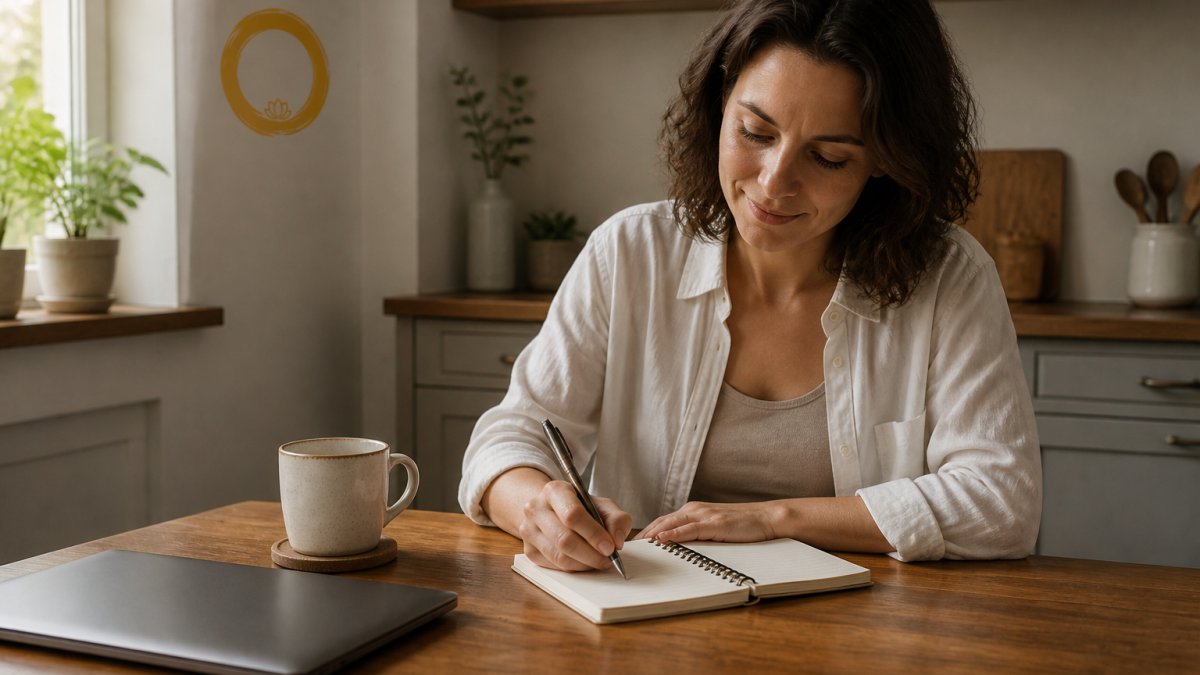
Start with a three-part morning:
- One minute of breathing before you check your phone.
- One small goal written on paper. Just one.
- One glass of water before coffee.
That is a routine you can keep on a bad day. And a routine you keep on a bad day is the only kind that counts.
Evening works the same way. Dim the lights, write down tomorrow's top task, and close the laptop. A short wind-down tells your body the day is over.
Why routines fail, and how to restart. Most routines break for predictable reasons: a late night, a sick child, a travel day, a shift change, or a stretch of low motivation. The mistake is treating a broken routine as a failed one. A better approach is a restart rule. Decide in advance that a missed day is not a missed week, and pick the smallest possible version of the routine to do the next day.
Personalize it to your anxiety pattern. A one-size-fits-all routine ignores what actually triggers your anxiety. If your anxiety spikes in the morning before work, put your routine there. If it builds in the evening, protect the wind-down. If your anxiety shows up as physical tension, add a two-minute stretch. If it shows up as racing thoughts, add a short brain dump before bed.
Keep it low-cost and accessible. A routine does not need an app, a subscription, or special equipment. A notebook, a phone timer, and a glass of water are enough. If a gym membership or a meditation app is out of reach, use free alternatives: a walk, a public library, a free breathing timer, or a short guided audio from a trusted organization. If mobility is limited, adapt the movement portion to seated options. The goal is a routine that fits your life, not one you have to buy your way into.
What to Ignore, What to Track, and When to Get More Support
Tracking helps you know what is working. But track too much and the tracking becomes its own source of stress.
Keep it simple. Once a week, rate your anxiety from 1 to 10 and note which habit you kept. That is enough data to spot a pattern.
| What to track | How often | Why it helps |
|---|---|---|
| Anxiety level (1-10) | Weekly | Shows the trend, not the bad day |
| Sleep and bedtime | Daily, one line | Links restless nights to rough mornings |
| Movement | Daily, yes or no | Proves small activity counts |
| Breathing practice | Daily, yes or no | Builds the habit loop |
Here is where honesty matters. Self-help has limits. If anxiety is disrupting sleep, work, or relationships for weeks, talk to a doctor or a licensed therapist. That is not failure. It is the smart move.
The NHS guide to anxiety, panic and fear lists clear signs that professional support is worth pursuing.
For a structured, low-pressure way to build these habits, Zen Power Mastery offers short, page-by-page tools designed for real life, not retreat life. The Mind's guide to everyday wellbeing is another grounded reference if you want more reading.
Frequently Asked Questions
What daily habits can help reduce anxiety?
The habits that help most are small and repeatable: a consistent bedtime, ten minutes of walking or movement, slow breathing before stressful moments, a short mindfulness pause, regular meals, and a few minutes of journaling to deal with anxious thoughts. None of these fixes anxiety overnight. The value comes from repetition, because a steady daily routine gives your nervous system predictable signals that you are safe. Start with one habit, keep it for two weeks, then add another.
How can I calm down quickly when I feel anxious?
Use a breathing exercise for anxiety that slows your exhale. Breathe in through your nose for four counts, then out for six to eight counts, and repeat for about two minutes. A longer exhale signals your body to shift out of fight-or-flight. Pair it with a grounding step: name five things you can see, four you can touch, three you can hear. This combination works in a meeting, on a commute, or before a difficult conversation, and no one around you needs to know you are doing it.
Can a daily routine help with anxiety?
Yes, and the effect is mostly about predictability. Simple routines for anxiety work because they remove small decisions and give your day a known shape: a set wake time, a short walk, meals at regular hours, a wind-down before bed. When your anxious mind is scanning for threats, a routine answers some of that uncertainty before it builds. Keep the routine short enough to survive a busy week. A routine you abandon after four days helps no one.
How do I deal with anxious thoughts without fighting them?
Stop trying to argue the thought away. Instead, write it down exactly as it appears, then ask two questions: what evidence supports it, and what would I tell a friend who said this? This is how to deal with anxious thoughts in a way that lowers their volume rather than feeding them. You can also label the thought out loud as a thought rather than a fact. If anxious thoughts keep disrupting your sleep, work, or relationships for weeks, talk to a doctor or therapist.
Anxiety rarely disappears on command, but it does respond to steady, small actions repeated over time. Zen Power Mastery builds practical, Zen-inspired guidebooks and courses around exactly that idea: short structured practices, steady momentum, and tools that help you restore energy and set healthy boundaries. Start with a free reset and give yourself one calm, repeatable step at a time.